You noticed it in the mirror on a Tuesday. A perfectly round, coin-sized patch of completely bare skin on the side of your head — smooth, clean, and completely hairless in a way that nature rarely produces by accident. Your first thought was denial. Your barber confirmed it with that particular grimace barbers reserve for things they would rather not say. Your mother called it stress. Your colleague at work had a theory involving shampoo. Your well-meaning uncle suggested onion juice. And your dermatologist — after a five-minute consultation — handed you a prescription for a steroid cream and told you it might grow back on its own. Might. What nobody told you — clearly, honestly, helpfully — is that alopecia areata is an autoimmune condition. Your immune system, for reasons it has not bothered to explain, has decided your hair follicles are the enemy and is systematically attacking them. Understanding this changes everything about how you approach treatment. And it is why homeopathic medicine for alopecia areata — which works at the immune system level — is the conversation worth having before you spend six months applying a cream to a problem that originates in your white blood cells.
What Is Alopecia Areata — and Why Is Your Immune System Targeting Your Hair?
Alopecia areata is an autoimmune condition in which the body's immune system — specifically T-lymphocytes — attacks the hair follicles, causing them to stop producing hair. The follicles themselves are not destroyed (which is the medically important distinction, and the reason regrowth remains possible), but they are suppressed into a prolonged resting phase that produces the characteristic smooth, round patches of hair loss.
The patches are distinctive: perfectly circular or oval, completely smooth, without scaling or redness, and appearing seemingly overnight — which is exactly as alarming as it sounds. One day there is hair. The next, there is a circle of bare scalp that looks like a poorly placed tonsure.
Alopecia areata can stay as one or two patches. It can progress to multiple patches across the scalp. In more extensive cases, it progresses to alopecia totalis (complete scalp hair loss) or alopecia universalis (complete body hair loss, including eyebrows and beard). Most men with alopecia areata are dealing with the patchy form — but the unpredictability of progression is one of the most psychologically taxing aspects of the condition.
Why the Immune System Does This
The immune system normally maintains a state of "immune privilege" around hair follicles — a protected zone in which immune surveillance is reduced. In alopecia areata, this privilege breaks down. T-cells enter the follicle, identify it as a target, and mount an inflammatory attack. What triggers this breakdown varies — genetic predisposition, a significant viral illness, prolonged severe stress, or sometimes no identifiable trigger at all. The follicle survives but goes dormant. The hair falls out. The patch appears.
This autoimmune mechanism is why alopecia areata so frequently coexists with other autoimmune conditions — thyroid disease, vitiligo, and atopic conditions are common companions — and why stress so reliably triggers or worsens it. The immune system is not just attacking randomly. It is responding to a constitutional pattern of immune dysregulation that has a cause, even when that cause is not immediately obvious.
The Psychological, Social, and — Let Us Be Honest — Matrimonial Reality
Let us talk about what the medical literature euphemistically calls "quality of life impact" — which in reality means: alopecia areata is genuinely difficult to live with, and not just because of the hair.
Hair is identity. Particularly for men in their twenties and thirties — the age group most commonly affected — a sudden, visible patch of baldness in a non-pattern location does not read as normal male hair loss. It reads as something visibly wrong. People notice. People stare. People ask. And the worst part is the unpredictability — not knowing whether the current patch will regrow, stay, expand, or be joined by three new ones next month.
The social dimension is real. Job interviews, first dates, photographs, weddings — every context where appearance carries weight becomes an exercise in managing what other people are noticing. Some men become experts at styling hair over patches. Others retreat into hats. A not insignificant number simply stop attending events they would otherwise have enjoyed.
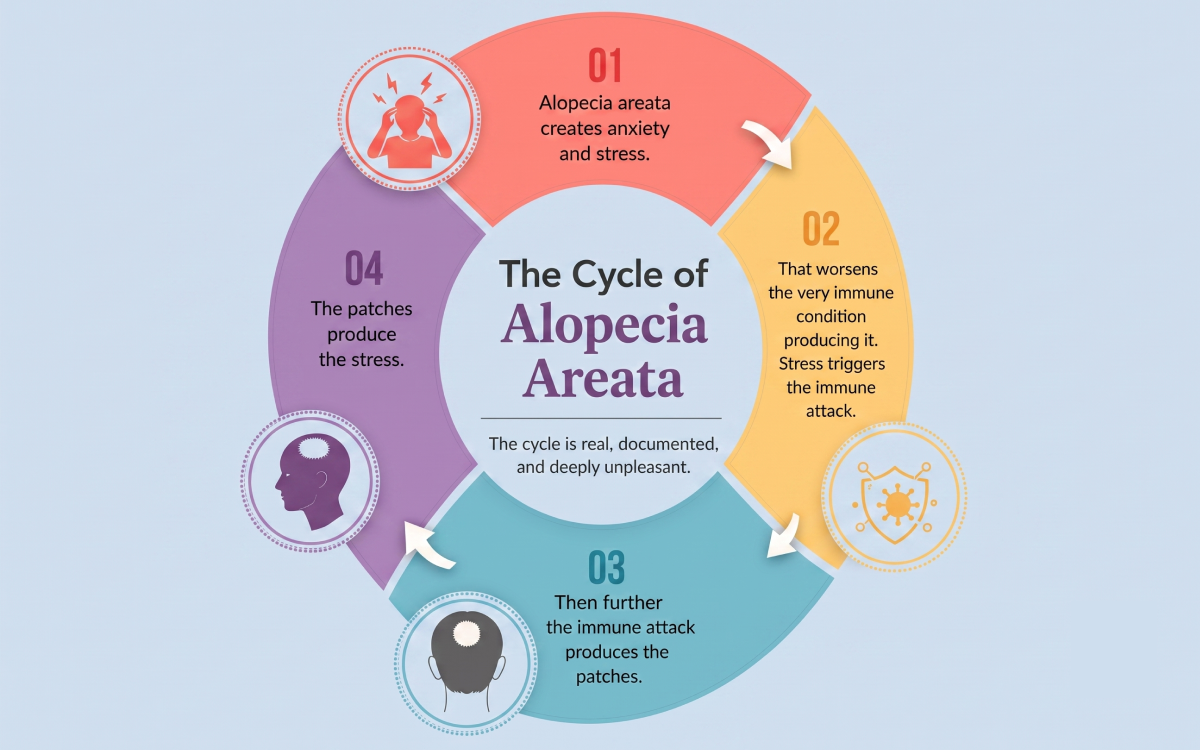
In the Indian matrimonial context — where photographs circulate among families before introductions are made and where visible health conditions carry social weight that polite conversation never acknowledges — alopecia areata creates anxiety and stress that then, in a particularly cruel irony, worsens the very immune condition producing it. Stress triggers the immune attack. The immune attack produces the patches. The patches produce the stress. The cycle is real, documented, and deeply unpleasant.
The psychological dimension is not separate from the medical dimension. It is part of it. And a treatment approach that addresses the constitutional immune picture — including the stress response, the emotional pattern, and the individual's overall resilience — is directly addressing one of the condition's primary drivers.
Why Steroids and Minoxidil Are Not the Complete Answer
The conventional treatment toolkit for alopecia areata includes topical and intralesional corticosteroids (steroid injections directly into the patch — which are as comfortable as they sound), oral steroids for more extensive cases, minoxidil to stimulate follicle activity, and newer JAK inhibitors for severe cases.
Here is an honest assessment of what these achieve: they can suppress the immune attack locally and stimulate some regrowth — and for active, progressing alopecia, they provide valuable short-term control. But they do not correct the immune dysregulation that produced the condition. The moment steroids are stopped, the immune attack often resumes. The patches return. Sometimes they return worse. The regrowth achieved while on treatment — which is frequently incomplete and uneven — retreats.
This is the ceiling of treatment-that-suppresses-without-correcting. It manages the condition while active. It does not change the underlying immune pattern that keeps producing it.
Homeopathic treatment for alopecia areata aims at that underlying pattern — working constitutionally to reduce the immune system's tendency to attack the hair follicles, restore immune privilege in the follicle environment, and support the conditions under which genuine, sustained regrowth becomes possible.
How Homeopathic Medicine for Alopecia Areata Works
The Autoimmune Pattern Is the Treatment Target
Every man with alopecia areata has a constitutional story. The patches appeared after a viral illness — or after a relationship breakdown — or during a period of work pressure so sustained that the immune system simply hit its limit. Or there is a family history of autoimmune conditions. Or thyroid function is slightly off. Or the stress response is chronically activated in a way that keeps the immune system in a state of low-grade agitation.
A Methodex homeopathic doctor assessing alopecia areata will investigate thoroughly and with that picture, the constitutional remedy is selected — one that addresses the autoimmune pattern, the stress-immune relationship, and the individual's complete constitutional susceptibility. The scalp is where the condition is expressed. The immune system is where it is being treated.
Commonly Indicated Constitutional Pictures
For educational purposes only — remedy selection must always be made by a qualified homeopathic doctor after individual assessment.
Men with alopecia areata following grief, loss, or prolonged emotional suppression — where the hair loss followed a bereavement, a relationship breakdown, or years of internalised stress — often present a constitutional picture pointing toward deep-acting remedies that address the grief-immune connection.
Men with alopecia associated with anxiety, perfectionism, skin sensitivity, and a generally reactive constitution — where stress triggers both the immune attack and noticeable physical responses — present a different constitutional picture with its own specific remedy landscape.
Men with alopecia following acute illness or significant physical stress — a viral infection, surgery, or prolonged overwork — where the immune system appears to have been knocked off its regulatory balance by a specific event — require yet another constitutional approach.
What Supports Recovery — Practically and Daily
Manage stress as a clinical priority, not an afterthought. The stress-alopecia connection is direct and physiological. Ten to fifteen minutes of breathwork, meditation, or deliberate relaxation daily measurably reduces cortisol and its downstream effect on immune regulation. This is not a soft recommendation. It is a treatment component.
Sleep properly. Immune regulation occurs substantially during deep sleep. Chronic sleep deprivation is a documented immune disruptor and a significant factor in autoimmune flares. Seven to nine hours is not a luxury for someone with alopecia areata. It is part of the management protocol.
Eat to support immune regulation. Anti-inflammatory foods — omega-3 rich sources like walnuts and flaxseed, colourful vegetables, zinc-rich foods like pumpkin seeds and legumes — support the immune environment. Zinc deficiency in particular has been associated with alopecia areata in multiple studies.
Check thyroid function. Thyroid dysfunction — particularly subclinical hypothyroidism — frequently accompanies alopecia areata and can independently worsen hair loss. A thyroid panel is worth requesting if not already done.
Stop Googling at 2 AM. Genuinely. The anxiety spiral that alopecia areata produces — searching for before-and-after photos, reading about progression to totalis, comparing regrowth timelines — raises cortisol, reduces sleep quality, and feeds the immune dysregulation that is producing the patches. Some things are better researched once, calmly, in daylight.
Conclusion
Alopecia areata arrived uninvited, made itself visible at the worst possible moments, and has so far responded to treatment with the enthusiasm of a house guest who has no intention of leaving. But it is not untreatable. It is not random. And it is not — despite what the condition makes you feel — permanent.
It is an autoimmune condition with a constitutional pattern that can be understood, addressed, and progressively corrected. Homeopathic medicine for alopecia areata works at exactly this level — not suppressing the immune attack with steroids while leaving the underlying dysregulation intact, but working constitutionally to restore the immune system's appropriate relationship with the hair follicles it should never have been targeting in the first place.
At Methodex, our homeopathic doctors specialise in the constitutional assessment and treatment of alopecia areata — taking the complete immune, stress, and constitutional picture before prescribing, because the scalp is where this condition shows up, but the immune system is where it needs to be treated.
Book your consultation with a Methodex homeopathic doctor today — and give your immune system something better to do than attack your hair.