There's a particular kind of tiredness that comes with trying to conceive month after month — the tiredness of hope and disappointment on repeat, of tracking apps and ovulation kits, of well-meaning relatives asking "any good news yet?" For many women, the path through infertility becomes a blur of tests, scans, hormone injections, and appointments — often with frustratingly little explanation for why things aren't working. Conventional medicine has given the world remarkable tools like IVF and hormonal therapy, and for many, these are exactly the right path. But increasingly, women are also asking a quieter question: is there something gentler I can try alongside this — something that looks at my whole self, not just my lab reports? This is where homeopathic medicine for infertility enters the picture — not as a competitor to modern medicine, but as a companion to it. It looks at your body, your hormones, your emotions, your sleep, your stress, and yes — even your intimacy and libido — as parts of one connected story. In this blog, we'll walk through how homeopathy supports women on this journey, what it can realistically offer, and how it fits alongside — not instead of — the medical care you may already be receiving.
Why So Many Women Are Quietly Exploring Homeopathy Treatment for Pregnancy Alongside Fertility Treatment
Infertility is almost never about just one thing. It's hormones and stress and sleep and the emotional weight of waiting and sometimes conditions like PCOS, thyroid imbalance, or structural issues — all layered together. Conventional treatment is excellent at targeting specific, measurable problems one at a time. Homeopathy approaches things differently — it tries to understand the whole pattern of a woman's health, and works to gently nudge the body back toward its own natural balance, rather than overriding it from the outside.
The Part Nobody Talks About — How Much the Mind Affects the Body
If you've ever felt like your body "knows" you're anxious about conceiving — and somehow that anxiety seems to make everything harder — you're not imagining it. The emotional weight of trying to conceive is real, and it doesn't stay neatly separate from your physical health. Stress, grief, disappointment month after month — these don't just affect your mood, they ripple into your hormones, your sleep, and your cycle. One of the things homeopathy does well is take this seriously from the very first conversation — not as an afterthought, but as a genuine part of the picture. Many women say that simply being asked "how are you feeling through all this?" — and having that question matter to their treatment — is itself a turning point.
What's Really Going On? Understanding the Many Faces of Female Infertility
Before any treatment — homeopathic or otherwise — can really help, it's worth understanding what might be happening beneath the surface. Some of the most common contributors to female infertility include:
- Hormonal imbalances — irregular ovulation, PCOS, thyroid issues
- Blocked or damaged fallopian tubes
- Endometriosis or fibroids
- Age-related changes in egg quality
- Ongoing stress that quietly disrupts the reproductive cycle
Why a Lab Report Doesn't Always Tell the Whole Story but your fertility homeopath can
Two women can have the exact same diagnosis on paper — say, PCOS — and yet experience completely different symptoms, cycles, energy levels, and emotional states. A homeopathic approach pays attention to these differences. Instead of just asking "what's the diagnosis?", it asks "what does your body's pattern actually look like — your energy, your digestion, your sleep, your moods, your cycle history, even your libido?" This fuller picture often reveals things that a single test result simply can't capture — and it's this fuller picture that shapes a treatment plan built around you, not just your diagnosis.
How Homeopathic Treatment Actually Supports Fertility — In Everyday Terms
Without getting too technical, here's the simplest way to understand it: homeopathy doesn't try to "force" your body to ovulate, regulate, or perform on a schedule. Instead, it works with very gentle, individualised remedies that are selected based on your specific pattern of symptoms — physical and emotional both — with the aim of helping your body's own systems function more smoothly on their own.
For Stress-Driven Fertility Struggles
Many women find that their fertility struggles seem to have started — or worsened — during a particularly stressful period of life. A demanding job, a major life change, chronic sleep deprivation, constant irritability or being "wound up." Homeopathy often pays close attention to this connection between a high-pressure lifestyle and reproductive health, working gently to help the nervous system settle — which, for many women, seems to go hand-in-hand with their cycles becoming more regular too.
For Irregular Cycles & Hormonal Ups and Downs
For women dealing with irregular ovulation, unpredictable or painful periods, or the hormonal swings that often come with PCOS, homeopathic treatment focuses on gently encouraging the body's hormonal rhythm back toward its natural pattern — rather than imposing an artificial one. This is often a gradual process, but many women describe it as their cycles slowly becoming more "their own" again, rather than something managed entirely by medication.
Low Libido — The Silent Struggle That's Closely Tied to Fertility
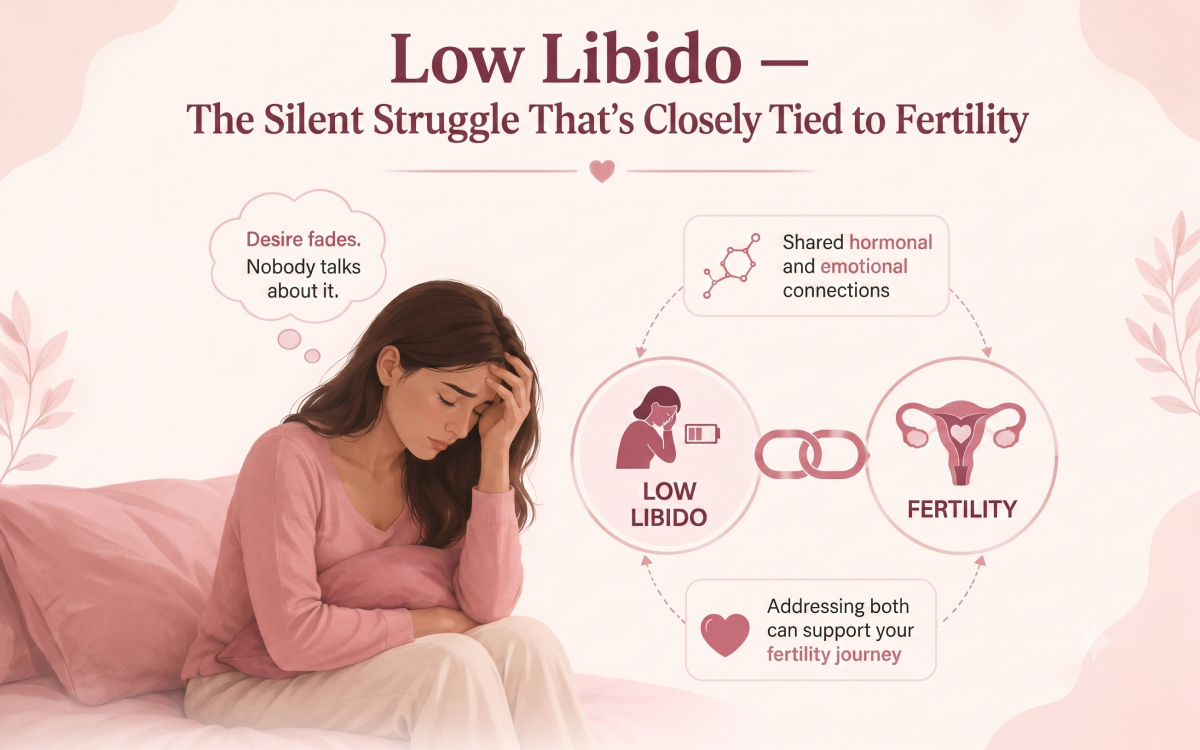
Somewhere between the ovulation tracking, the timed intimacy, and the monthly disappointment, something quietly shifts for many women — desire fades, and nobody really talks about it. It's rarely raised at doctor's appointments, rarely mentioned to friends, and often carried alone, sometimes with a layer of guilt on top. But low libido isn't just an emotional footnote to fertility struggles — it's often deeply woven into the same hormonal and emotional fabric, and addressing it can be a meaningful part of the fertility journey itself.
Why Desire Often Disappears During a Fertility Journey
Low libido rarely has a single cause — it's usually a combination of factors quietly stacking up. Hormonal fluctuations, especially involving estrogen and thyroid function, can directly affect desire. The emotional weight of trying to conceive — anticipation, disappointment, and the pressure of "performing on schedule" — can turn intimacy from something natural into something that feels like another task on a checklist. Chronic stress and poor sleep, common companions on this journey, further dampen the body's natural responses. And for women undergoing fertility treatments, hormonal medications themselves can sometimes affect desire as a side effect — something that's often not discussed in advance, leaving women feeling confused or even isolated when it happens.
How Homeopathic Medicine for Instant Female Arousal and Approaches Low Libido Differently
Conventional approaches to low libido often focus narrowly — addressing it as a standalone issue, sometimes with little connection to what else might be going on hormonally or emotionally. Homeopathy takes a different view. Rather than isolating libido as "a problem to fix," it looks at it as one expression of the body's overall state — closely connected to hormonal balance, emotional wellbeing, energy levels, and stress. Treatment is selected based on each woman's unique pattern: for some, addressing underlying anxiety and emotional exhaustion brings the most noticeable shift; for others, supporting hormonal balance has a more direct effect. The approach is gentle, individualised, and doesn't rely on stimulating desire artificially — instead, it aims to help the body's natural responses return on their own, as overall balance improves.
The Fertility Connection — Why This Matters Beyond the Bedroom
Here's where it all comes together: low libido and fertility struggles often share the same root drivers — hormonal imbalance and emotional strain. This means that when homeopathic treatment supports hormonal balance and helps ease the emotional burden of the fertility journey, many women notice improvements in both areas simultaneously — their cycles becoming more regular, and their sense of desire and connection returning. It's rarely described as a dramatic change. More often, women describe it simply as "feeling like themselves again" — and for many couples, that shift in connection and intimacy becomes part of the journey toward conception itself, not separate from it.
What About Blocked Fallopian Tubes? Where Homeopathy Fits — and Where It Doesn't
Let's be honest here, because women deserve honesty on this topic. Blocked fallopian tubes are a structural issue — and structural issues sometimes need structural solutions, including surgical procedures. This is one area where homeopathy is not a substitute for proper medical evaluation. That said, for milder cases — where there's inflammation or scarring rather than complete blockage — some women explore homeopathic support alongside medical care, aimed at reducing inflammation and supporting overall reproductive tissue health. The key word here is alongside — this should always be discussed openly with your treating doctor, never as a replacement for medical evaluation.
It's Not Just a "Her" Issue — Male Fertility Matters Too
If you've been carrying the emotional and physical weight of fertility testing largely on your own — know this: in close to half of all cases where couples struggle to conceive, male fertility factors play a meaningful role too, including sperm count and motility. A good fertility-focused homeopathy clinic doesn't just focus on one partner — it looks at both, because addressing things together, as a couple, often leads to better and faster outcomes for everyone involved. If this resonates, it might be worth a gentle conversation with your partner about exploring this together — not as "whose fault is it," but as "what can we do, together."
What Actually Happens at a Homeopathic Fertility Consultation?
If the idea of a homeopathic consultation feels unfamiliar or even a little intimidating, here's what it generally looks like in practice:
- A long, unhurried conversation — about your health history, your cycles, your lifestyle, your diet, your sleep, and yes, your emotional state too
- Looking at patterns, not just numbers — how your body responds to stress, weather, food, energy through the day
- A treatment plan built for you — gentle remedies combined with practical lifestyle and dietary guidance
- Ongoing check-ins — because your body's response over time is what guides the next steps, not a single visit
"How Long Will This Take?" — An Honest Answer
This is the question every woman asks, and the honest answer is: it depends. Some women notice their cycles becoming more regular within a few months. Others — particularly where structural issues or long-standing hormonal imbalances are involved — may need a longer, more patient approach over several months. What homeopathy generally doesn't offer is an overnight fix — but what it often does offer is a gradual, sustainable shift, rather than a result that disappears the moment treatment stops.
"Can I Do This Alongside My Fertility Treatment?" — Yes, with One Important Step
This might be the single most common question women ask — and it's an important one. Generally speaking, homeopathic remedies are gentle and considered to carry minimal risk of interaction with conventional treatments. This is part of why many women feel comfortable exploring homeopathy alongside — or even before — more involved medical procedures. But there's one non-negotiable step: be open with both your homeopath and your fertility doctor about everything you're doing. Not because either will judge you — but because your full picture, in both directions, helps everyone involved take better care of you.
Your Fertility Story Is Yours — And It Deserves to Be Heard, Not Just Treated
Female infertility is rarely just a medical issue — it's an emotional one, a relational one, and often a deeply personal one too. It touches your hormones, yes — but also your sense of self, your relationship, your hopes for the future. Homeopathic medicine for infertility doesn't promise to replace the medical care you may need. What it offers instead is a gentler companion on the journey — one that takes the time to understand your whole story, including the parts that often go unspoken, like stress, emotional exhaustion, and intimacy.
If you've been feeling like just another number on a chart, and you're looking for someone who will actually sit with your story — Methodex is here for that conversation. Reach out to Methodex today, and let's take the next step together — at your pace, on your terms.
Book a compassionate, unhurried consultation with Methodex — for fertility support that sees the whole you, not just your test results.
No judgment. No rush. Just care that listens.
Book Your Consultation Now